Today’s consumer capitalist societies present us with a paradox: We are told year in and year out that living standards are rising, but many people—especially younger people—can feel their quality of life decline as time goes on. This feeling is palpable and can be seen in the hardest of the quality of life indices, such as the suicide rate and the rates of drug addiction and overdose. Noneconomic measures show a large decline in quality of life in recent years, but economic metrics show it is increasing.
The old Marx Brothers phrase comes to mind: “Who are you going to believe, me or your lying eyes?” It is time for economists to admit that their metrics are broken. In this essay, I will introduce a conceptual framework to understand what has gone wrong and suggest some provisional ways to fix it.
Classical, Neoclassical, Clinical
Economic theory is typically divided into two broad periods: the classical and the neoclassical. The neoclassical period arose in the nineteenth century, partly in response to Marxism, in the work of economists like Carl Menger and William Stanley Jevons. Neoclassical economics is characterized by a focus on rationality and utility maximization. These are the concepts that any undergraduate who takes a course in economics will be introduced to almost immediately. Students are taught to think of the world as a large collection of goods and services that they must choose between while only having access to a limited budget. “Rational” consumers are those who get the “best bang for their buck” by choosing the basket of goods and services that makes them most content—this is what the economists refer to as “maximizing” utility.
The reader will quickly notice how subjectivist this framework is. This mode of analysis makes no judgment about the consumption preferences of the consumer. Suppose that one consumer maximizes his utility by hoarding empty beer cans. The economist will say that because the cost of empty beer cans is basically zero, the hoarder will be a very happy individual since he will have access to almost infinite empty beer cans. A psychologist may say something different altogether, but the economist is eminently, almost comically, liberal in his approach.
The classical tradition in economics was very different. The classical tradition ran from Adam Smith through David Ricardo to Karl Marx, who is generally recognized as the last major classical economist. The classical tradition drew on the work of the ancient philosophers, notably Aristotle, in formulating its basic approach to commerce. In the classical tradition, there was a distinction between the “use value” of an item and its “exchange value.” The exchange value of an item was simple enough: it was the number of other items any given item was worth—or when money is introduced into the economy, the monetary value of an item in the market. The use value of an item was quite different. Contemporary philosophers might call use value an “essentialist” property, and this notion drew on the philosophies of the ancient world, in which the essence of things was taken very seriously. For classical economists, an item’s use value was its actual usefulness or worth to the “good life.”
Here we see a much more objectivist stance than we see in the modern neoclassical approach to economics. Take the example of the hoarder who desires to hoard as many empty beer cans as possible. The classical economist will be nowhere near as liberal as the neoclassical economist when confronted with such a phenomenon. Rather, the classical economist will state plainly what is obvious to most of us: beyond the capacity to recycle the raw materials, the empty beer can has almost no use value, and the hoarder is simply being irrational and may even be mentally ill. Here, the classical economist agrees with the psychologist, while the neoclassical economist remains trapped in the madhouse.
The Exchange Problem
What does all this have to do with the measurement of relative wealth across space and through time? Surely, these are old, arcane debates, bordering on the metaphysical. Not so. In fact, they have an enormous impact on how people view the world today—especially policymakers and politicians. The reason for this is because, especially in the last thirty years, policymakers and politicians have become obsessively focused on maximizing economic growth. Here, they typically refer to gross domestic product (GDP). If GDP is growing, we are told, society is getting ever wealthier. Since we live in commercial societies and the politician’s main goal is to maximize the wealth of his population, GDP growth should be prioritized over almost everything else.
Buried deep in the GDP metrics we use, however, are assumptions that are almost identical to the neoclassical conception of value. GDP is measured by the number of transactions that occur in any given geographic location over any given period. To get an intuitive sense of this, imagine a household with two parents and two children. Let us imagine we only want to measure the internal GDP of the household itself. That is, we ignore the income that flows into the household from the parents working or the children opening a lemonade stand outside the house. We also ignore the expenditure that flows outward on goods and services. Reduced to the internal GDP of the household, the only relevant payments will be between the parents and the children. The internal GDP of the household will thus consist only of regular payments from the parents to the children in the form of pocket money and any additional payments from the parents to the children for additional labor carried out, such as mowing the lawn or doing the dishes. When a child loses a tooth, even the tooth fairy may contribute a few units of GDP by slipping a banknote under the child’s pillow.
The reason that I use this example is to highlight something very important about the GDP framework: the parents and children interact in an enormous number of ways, but only monetized actions are recorded as contributing to GDP. If the mother cleans the dishes and the father mows the lawn one week, but the children do both for extra pocket money the next week, only the children’s actions are recorded as GDP. A classical economist would see a problem with this. After all, the use value of cleaning the dishes or mowing the lawn is the same regardless of whether the exchange value is different depending on who is undertaking it. At an intuitive level, the classical economist is correct.
Neoclassical economists have long been aware of this problem, but they have defended the GDP framework by saying that unpaid labor and similar non-transactional interactions are a relatively small part of economic activity and remain relatively constant over time. These two claims are related: these sorts of quasi-economic interactions start small, and because they remain a constant share of total quasi-economic interactions over time, they stay small. While this may have been a defensible position in the past, it has become less and less defensible in an age when we are increasingly inclined to monetize images and human interactions.
There now seems to be an impulse on the part of consumerist capitalism to try to monetize as many relationships as possible to maximize GDP. Consider two statistics that put this in stark contrast. Between 2008 and 2018, the number of men aged 18–34 who reported not having sex in the past year rose from 7 percent to 23 percent.1 Filling this gap is an explosion of online “virtual prostitution” and pornography. Between 2019 and 2023, the online virtual prostitution website OnlyFans saw its revenue climb from $43 million to $1.3 billion, which represents a 20 percent compound growth rate.2 What we are seeing here is the replacement of normal human relationships with virtual monetized relationships. If young men were having sex at normal rates with their would-be wives or girlfriends, it would not add to GDP. But because they are not and must instead seek out virtual prostitutes, their activity is monetized and therefore adds to GDP.
Not only is this perverse, but it also represents a decline in use value and a fall in living standards. The use value of sexual relationships is both psychological and procreative. From a psychological perspective, data show clearly that people who are in sexual relationships are generally happier than people who are not.3 Meanwhile, the psychological evidence that pornography drastically damages mental health is crystal clear.4 From a procreative perspective, society needs people to enter stable sexual relationships to reproduce the species. In addition to this basic biological need, reproduction is required to replace and increase the labor force, which is needed to maintain and grow living standards.
The substitution of online pornography for real-world relationships also represents a fall in living standards because these young men now must pay for a far less satisfying product, thus reducing their real income. It could be argued that virtual prostitutes have seen an increase in their living standards, but in reality, they have likely just replaced being in a relationship in which a man pays for gifts, trips, and other things with virtual prostitution. Overall, this dynamic is leading to a significant fall in the standard of living in the societies impacted by it.
Consumption Widening and Consumption Deepening
This paradox is perhaps best explored with reference to some concepts borrowed from macroeconomics. In the macroeconomics of capital development, economists typically distinguish between “capital widening” and “capital deepening.” To explain these concepts, we might consider an economy focused on agriculture. Imagine that all the farms in this economy have a rather primitive capital stock. That is, farmers mainly work the farms with old-fashioned plows operated either by hand or by horses. Imagine that investment in this economy is increased, and tractors are then introduced into the economy, which massively increases the productivity of the farms. As each farm gets a tractor (a technology that already existed but was lacking on the farms due to a lack of investment), the amount of capital is increased across space, across all the farms. We can refer to this as capital widening.
Now consider what future investment in this economy might look like. It will have to focus on using new technologies to increase the productivity of the farms incrementally. We might think of the first phase as picking the low-hanging fruit by investing in extant technology that provides an enormous increase in productivity. In the second phase, farmers must seek new technologies that increase productivity marginally. For example, they may install a new engine in their tractor that allows it to work more efficiently. Economists call this second phase “capital deepening,” which is characterised by an attempt to eke out marginal productivity gains by intensely focusing on increasing efficiencies.
We can borrow these terms to describe what has happened in the consumption space of late consumer capitalism. In the first phase of the development of consumption, new technologies that drastically improve living standards are introduced. We might think of the proliferation of access to running water in Western societies in the twentieth century right up to the distribution of extremely useful gadgets—refrigerators, washing machines, etc.—especially in the 1940s and 1950s. We can refer to this phase of increased consumption as “consumption widening.” Consumption widening clearly changes the way we live for the better. No one with access to running water would want it to be cut off, just as no one with access to a fridge would like to see it taken away. The case for these new consumer items is rock-solid from the perspective of use value.
Now, consider the replacement of sexual relationships with virtual prostitution that we discussed above. This involves relationships that were previously not monetized becoming monetized. There are endless examples of these relationships in modern economies. For example, an entire health care insurance industry has sprung up in the United States that uses opaque billing techniques to ration the amount of health care provided to American consumers. In the past, this was a much simpler exchange relationship between a patient and a doctor; now there are endless layers of paid middlemen. Each time a middleman is paid, this adds to GDP, but from an objective perspective, this leads to reduced rather than increased use value. This colonization of human relationships by exchange relationships can be called “consumption deepening.”
Consumption deepening is the logical result of a society that considers rising GDP as a good in and of itself. Past a certain point, people do not need large increases in exchange relationships. Once they have their fridge, washing machine, car, dishwasher, and so on, the need for more use values starts to decline. Past a certain point of consumption, people become largely satiated, and their consumption should grow slower than before. But late consumer capitalist societies cannot tolerate this because consumption growth is seen as a prerequisite for GDP growth. As a result, economic incentives begin to favor “deepening” consumption by monetizing as many relationships as possible. This also explains the increasing rush to monetize images—because images exist to briefly capture a person’s attention, and the incentives in late consumer capitalism are structured to capture as much monetized attention as possible.
Like a good economist, we can model this relationship quite easily. Consider the following diagram. On the vertical axis, we see use value, the true usefulness that people derive from economic relationships. On the horizontal axis, we see expenditure identical to GDP—that is, the amount of money that people spend in any given time period. The curved line shows the relationship between the two. At the beginning, moving up to point e1, the use value rises as expenditure rises. This is the period of “consumption widening”—when people start to get access to products that drastically raise their living standards. Between points e1 and e2, we see a sharp slowdown in the increase of use value. This is the period when consumption widening starts to transition to consumption deepening. Past point e2, we are fully in the period of consumption deepening. As we can see, expenditure produces no actual increase in use value.
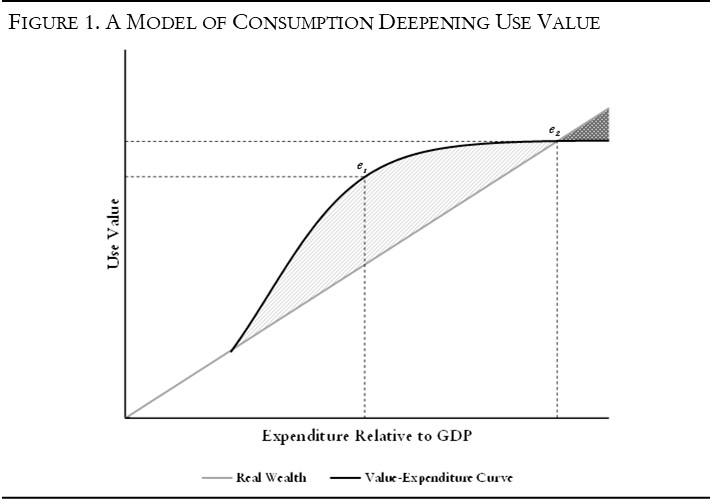
Consider also the line coming from the bottom left-hand corner of the diagram and rising 45 degrees. We can call this the line of “real wealth”—that is, the line that allows us to conceptualize whether increased expenditure is additive to human flourishing or harmful to it. When the real wealth line is below the use value-expenditure curve, increased expenditure adds to human flourishing. We see this in the light grey shaded area. But when the real wealth line is above the use-value-expenditure curve, increased expenditure actively detracts from actual human flourishing. We see this in the dark grey shaded area, which represents the region of the virtual prostitution economy.
What does all this mean? For one, it means that we cannot say that increasing GDP shows a rise in living standards. As we have seen, rising GDP can be actively detrimental to living standards because it can represent a use-value-destructive—if not societally poisonous—process of consumption deepening. We need an alternative measure that factors in the qualitative aspects of consumption and assigns a negative value to forms of consumption that are detrimental to human flourishing. For example, virtual prostitution and America’s health care bureaucracy should not be included in such a measure; rather, they should be assigned a negative value and reduce the measure. Such a method would help policymakers focus on eliminating these poisonous phenomena.
This framework requires a classical vision of value itself. We need to have a framework that can actively distinguish between healthy sexual relationships and virtual prostitution and assign a positive value to the former and a negative value to the latter. Creating such a framework is far beyond the scope of this essay, but it undoubtedly implies a teleological approach that can define first principles and then tease out the use values of various relationships.
Consumption Deepening and the
Rent Extraction Economy
Intuitively, consumption deepening will likely not have as significant an impact on an economy as consumption widening. The cost of a subscription app or the marginal revenue generated from the production of images surely cannot match the introduction of, say, a new household appliance or widespread access to electricity. Even if we allow our conception of value to be dictated by market exchange—that is, even if we allow the price paid for a consumption good to be a true reflection of its value—the price paid for images and app subscriptions simply cannot be compared to the price paid for a new household appliance.
Let us take some real-world examples to demonstrate this intuition.5 In 1947, the American manufacturer Bendix released its Bendix Deluxe model washing machine. It sold for $249.50, which is around $3,500 in today’s money after adjusting for inflation. We get a better sense of how large a consumption outlay this washing machine would have been if we compare it to the average American salary net of taxes at the time—around $2,300 a year. A Bendix Deluxe in 1947 would have cost around 10.8 percent of the average American salary. Let us compare that to the cost of a high-end washing machine today. The Bosch 300 series, which ranks as one of the best washing machines at the time of writing, costs around $1,250. This is just over 2.3 percent of the average annual American salary net of taxes ($53,280). We can, therefore, see that a washing machine cost the average American almost five times more relative to 1947 salaries than it does today.
Yet even $1,250 is not an insignificant amount of money for the average American. Buying a washing machine today is still a relatively big expense for anyone outside of the very wealthy. It is such a large purchase that it is not uncommon to buy items like washing machines through lease arrangements of various types. These machines even turn up in pawn shops when times are hard. Compare this to the costs of some more excessive products of an economy far into the consumption deepening stage of development. OnlyFans subscriptions cost around
$5–10 a month, or around $84 a year. The lowest level of X Premium costs around $3 a month, to take a less extreme example. These costs are significantly lower than the $1,250 cost of a washing machine. But this is not even the most important point of comparison.
If the consumption-deepening model were truly adding use value, then one would expect that these new forms of consumption would increase to fully replace the falling prices of items like washing machines. Yet this is not happening.
We know that consumption today is higher than it was in 1947, so what are people consuming? Or, phrased differently, where is the extra income left over from the falling cost of washing machines being absorbed? The best way to look at this is to compare the weights in the Consumer Price Index (CPI) from the period of consumption widening to those of today.
The CPI is generated by statistics agencies to show how much of the average person’s income is spent on a given category of goods. The CPI weights are often thought of as a representative “shopping basket” of what the average consumer buys over the course of the average year. Changes in this “shopping basket” show directly what spending is absorbing the consumption segment of GDP.6 The following chart shows the CPI weights from 1947–49, when the phase of consumption widening was in full swing in the United States, and the CPI weights from 2024, when the economy had already undergone an extensive process of consumption deepening.
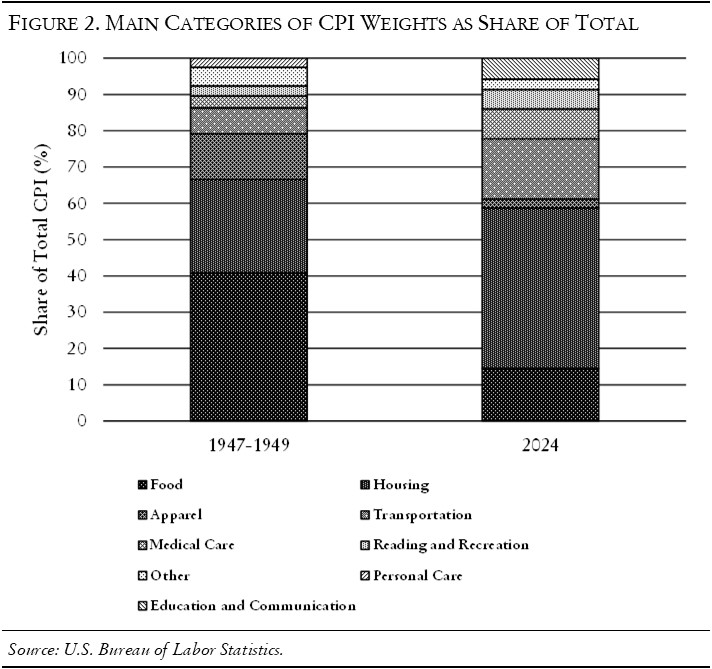
Here, we see the changes in the nature of the American economy. One aspect that stands out is the decline of the weight of food in the CPI, falling from 40.9 percent of the overall basket in 1947–49 to only 14.5 percent in 2024. The impact of consumption deepening is best measured by the category “Reading and Recreation.” This category includes subcategories such as “Televisions,” “Purchase, Subscription, and Rental of Video,” “Recorded Music and Music Subscription,” and so on. It includes, in other words, the production of images for consumption. We certainly do see an increase in this category, which has risen from around 2.8 percent in 1947–49 to around 5.3 percent in 2024, but relative to the entire basket, this increase is not very large, and it remains a relatively small category. We might say that if most of the effects of consumption deepening were rolled back to post–World War II levels, consumption in the United States would only fall by around 2.5 percent! Meanwhile, dollar-based consumption of food has been reduced by around 25 percent! Once again, our intuition is confirmed: the impact of consumption deepening is not sufficient to offset the lack of consumption widening that has taken place in the American economy.
The items absorbing income are crystal clear from this chart: “Medical Care,” “Education and Communication,” and “Housing.” “Medical Care” has risen from 3.3 percent of the basket to around 8.3 percent of the basket. Note that the increased weight does not reflect a rise in the quality of a given good or service. Food quality has likely risen since 1947–49—certainly in terms of the diversity of consumer selection—yet its weight has fallen. Americans are simply spending more money on health care. The same goes for education. “Education and Communication” has risen from basically 0 percent—we assume it was so small that it was previously contained in the “Other” category—to around 5.7 percent. The rise in the health care and education components of the basket, however, is nothing in comparison to the rise in the cost of housing. “Housing” has risen from around 25.7 percent in 1947–49 to around 44.2 percent in 2024. Here, the question of quality is even more straightforward. Anyone who has looked at the housing market knows that mid-century properties are typically better built than newly constructed properties and that they often sell at a premium. So, what is driving the rise in housing costs? The following chart breaks down the weights of the housing component by subcategory.
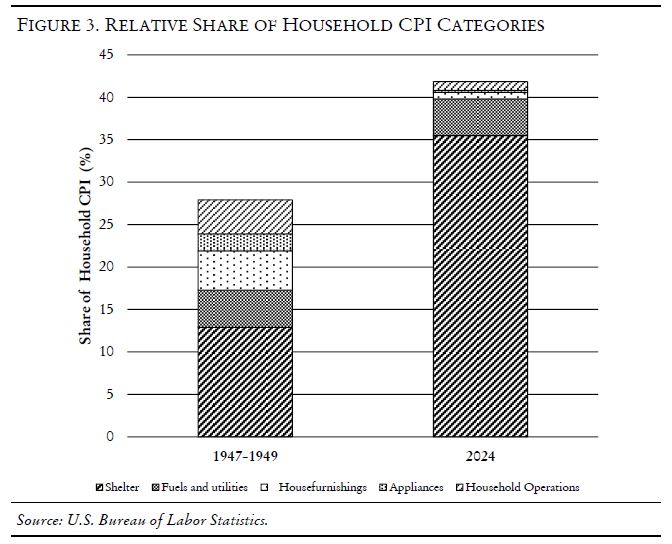
Here, we see that, apart from fuel and utilities, which have maintained roughly the same share of household consumption over time, all other non-shelter costs have fallen. In 1947–49, households spent around 10.6 percent of their income on costs associated with furnishing and running a household. By 2024, this had fallen to only 2 percent. This is the effect of consumption widening in action. Markets have massively driven down the relative cost of running a household. But when we look at the cost of housing itself—categorized as “shelter” in the CPI weights—we see something very different: the costs of obtaining housing have risen from 25.7 percent of household income in 1947–49 to around 44.2 percent of household income in 2024. The cost of obtaining housing has almost doubled. What explains this? It appears that, as consumption widening has furthered, late capitalism has turned to aggressive rent extraction mechanisms to absorb the excess income that useful consumption products can no longer absorb.
It is popular today to claim that the reason housing costs have risen is because there are not enough houses.7 A granular look at the data casts doubt on this, however, at least across the nation as a whole.8 In fact, the number of housing units per capita has been steadily rising since 1940 and has never really fallen. The size of households has also been falling in this period, but not by enough to account for the run up in housing costs. For example, the recent run-up in housing costs started in 2011. Since then, the median sales price of a home in the United States has risen from around $226,900 to around $419,200 at the end of 2024—an increase of around 85 percent. In the same period, the number of housing units per person stayed roughly constant at around 0.425. The average household size over this period fell from around 2.55 to around 2.5, a decline of just under 2 percent. If we believe the supply-and-demand story for housing, we are forced to accept that a 2 percent decline in the size of the average household with a steady amount of housing per capita generates an 85 percent increase in the price of housing. These numbers make no sense.
The simpler explanation is that the housing market has been financialized. As of 2024, one in six homes purchased in the United States were purchased by investment buyers—more than triple the amount of investment buyers that were in the market in 2000. For low-priced homes, the number purchased by investment buyers was one in four.9 Housing in America is being treated as a financial asset from which investors extract wealth—this is not unlike how land and property was treated in the feudal era.
Consumption deepening does not so much extract rent as it normalizes the basis of the rent extraction economy in the minds of the people who inhabit it. A company like OnlyFans may make the individuals who “work for them” (or perhaps more accurately, are exploited by them) a lot of money. But overall, its contribution to the actual economy is minor. Most rent extraction occurs in much more important areas, like housing and health care. The consumption deepening model instead creates the microeconomic conditions that lead consumers to accept the rent extraction model as “normal.”
Consumption deepening “virtualizes” many aspects of economic life and, in doing so, leads to an illusion of economic progress. While the cost of essentials like housing and health care rise, consumers are told that wealth is increasing despite these price increases thanks to the growth of the virtual economy. The virtual economy itself creates an increasingly illusory world where tangible goods and services fade into the background even though they make up a larger and larger share of a person’s actual expenditure. Meanwhile, the virtual economy brought about by consumption deepening conditions consumers to think that paying rents for things that they previously did not have to pay rents for is normal, and so this obscures the increasing rental extraction that is taking place on what were previously basic goods. Normalizing abnormal social relationships at a microeconomic level normalizes mass rent extraction at the macroeconomic level.
From Productivity Puzzle to Productivity Scam
In macroeconomics, there has long been a debate around the so-called productivity puzzle. In 1993, the economist Erik Brynjolfsson noted that, while the technology revolution of the previous two decades was obvious to anyone who compared an office in the early 1990s with an office in the late 1960s, productivity gains were unimpressive.10 This inspired the now well-known quip by Robert Solow, “You can see the computer age everywhere but in the productivity statistics.”
The reality is that this was not much of a puzzle at all. In 1967, the economist Nicholas Kaldor laid down his “growth laws,” which stipulated that the service sector had minimal capacity to increase its productivity in comparison to manufacturing.11 Since Kaldor first formulated these growth laws, they have been confirmed by empirical observation.12 The Western productivity slowdown is mainly due to moving from a manufacturing economy to a services economy.
But considering the facts of consumption widening and consumption deepening, we are confronted with an even more disturbing possibility: what if the productivity statistics in late capitalist societies are extremely misleading? Productivity is measured by dividing inflation-adjusted GDP by the labor force. As we have already discussed, however, the inflation adjustment of GDP is calculated using the weightings we examined in the last section. This means that when, say, the weight of “shelter” or “medical care” rise in the basket of transactions associated with these activities, they make up more and more of a share of inflation‑adjusted GDP. But it is unclear why we should consider, for example, rising rent costs or a bloated medical insurance bureaucracy as indicative of productivity growth.
The reality is that economic productivity is not organically related to the volume of monetary transactions taking place. The statistics we use to measure productivity assume that there is a relationship between these two things, and this may have been the case in the old consumption widening economy of the postwar period. But in the late capitalist economy, dominated by consumption deepening and rent extraction, this assumption simply does not hold.
This issue will also impact relative measures of economic size. Economists use a similar technique known as purchasing power parity (PPP) adjusted per capita GDP to compare the relative wealth of countries. But the PPP adjustment uses relative inflation metrics that rely on the weighting systems examined above. This means that if, say, the United States has an overinflated medical or educational bureaucracy that sucks up much more expenditure than the less onerous systems in Europe, this will artificially increase the relative statistical wealth of the United States relative to Europe. In effect, we are saying that because American health care is vastly more expensive than its European equivalent, and therefore absorbs more expenditure, the United States has a higher per capita income. This seems prima facie absurd: as someone who moves from Europe to the United States will tell you, one must spend significantly more as a percentage of income on a product that was either much cheaper or even free in Europe. Here, we are starting to see that issues related to consumption widening, consumption deepening, and rent extraction raise profound questions about how we think about economic progress and development.
An Ancient Quarrel
Better analysis of consumption deepening can help to explain the growing disconnect between the rising living standards suggested by economic statistics and the increasingly widespread perceptions of material decline among Western electorates. Although it may be possible to increase GDP by transforming ever-more aspects of life into monetizable consumption, we may be well past the point at which further consumption deepening detracts from actual consumer “utility” or human flourishing.
At the same time, goods that once composed far less of a person’s overall consumption basket—like health care, education, and housing—are sucking up much of the income that has been freed up by actual improvements in material conditions that were arrived at through the process of consumption widening. The reason for this is not because the quality of these goods has risen dramatically but rather because the markets for these goods have become heavily financialized and bureaucratized, thereby creating a massive sector of the economy that is based almost entirely on rent extraction.
This realization has profound implications not only for certain basic economic statistics, but also for the policy issues that have been shaped by those statistics. Beneath many of today’s debates may be much older quarrels between classical and neoclassical economics. Neoclassical assumptions about the relationship between consumer spending, welfare, growth, and national wealth that appeared to work well enough in the twentieth century may no longer be operative. Over many decades, actors in consumer capitalist societies have been incentivized to exploit the gap between GDP and real consumer welfare, gradually widening this gap into a chasm. Arguments defined in terms like “de-growth” versus “abundance,” therefore, may misstate the core problem, which fundamentally involves ancient questions concerning the difference between use value and exchange value and the difference between actual economic profit, which adds to the material wealth of society, and pure economic rent, which simply tries to colonize and monetize normal human activity.
This article originally appeared in American Affairs Volume IX, Number 2 (Summer 2025): 166–80.
Notes
1 Charles Fain Lehman,
“Who Are the Men without Sex?,” Institute for Family Studies, April 16, 2019.
2 C. J. Gustafson, “OnlyFans Financials Revealed,” Mostly Metrics, October 3, 2024.
3 Mane Kara-Yakoubian, “Study Finds People in Relationships Tend to be Happier Than Singles,” PsyPost, November 16, 2024.
4 Bob Petr and Michal Privara, “Pornography Consumption and Cognitive-Affective Distress,” Journal of Nervous and Mental Disease 211, no. 8 (2023): 641–46.
5 I take examples from the United States for several reasons. First, the United States has experienced the most dramatic “consumption deepening” in the world due to its early adoption of the consumerist economy and its current hyper-consumerist culture. Second, the United States has very good statistics on consumption, going all the way back to just after the Second World War. Third, the “rent extraction economy” in the United States is much more advanced than in European countries because of a lack of government intervention to control costs, especially in the health care and university loan system. The United States might be seen as a sort of “ideal type” of the consumption-deepening-cum-rent-extraction economy that other economies will tend toward if they undergo the same economic processes through time.
6 It does not matter if we think any given basket is poorly calculated because CPI—or, more precisely, a variant called the “GDP deflator”—is used to calculate inflation-adjusted GDP figures. So, if people use the standard statistics, even in arguing about how large an economy is or how fast it is growing, they will have the CPI weights “built-in.” Because policymakers use these standard statistics, it is fair to say that economic policy is geared toward a measure that incorporates the CPI weights.
7 Elena Patel, Aastha Rajan, and Natalie Tomeh, “Make it Count: Measuring Our Housing Supply Shortage,” Brookings Institution, November 26, 2024.
8 Brian Potter, “Is There a Housing Shortage or Not?,” Substack, May 11, 2022.
9 Lily Katz, “Investor Home Purchases Post Biggest Increase in Two Years,” Redfin, August 15, 2024.
10 Erik Brynjolfsson, “The Productivity Paradox of Information Technology,” Communications of the ACM 36, no. 12 (1993): 66–67.
11 Nicholas Kaldor, Strategic Factors in Economic Development (Ithaca: New York State School of Industrial and Labor Relations, Cornell University, 1967).
12 Nelson Marconi, Cristina Fróes de Borja Reis, and Eliane Cristina de Araújo, “Manufacturing and Economic development: The Actuality of Kaldor’s First and Second Laws,” Structural Change and Economic Dynamics 37 (2016): 75–89.